Mo logo [home] [lexicon] [problems] [tests] [courses] [auxiliaries] [notes] [staff] german flag

Mathematics-Online course: Linear Algebra - Matrices - Determinants

Oriented Volume


[previous page] [next page] [table of contents][page overview]

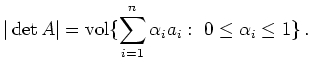
The absolute value of the determinant of a real matrix $ A$ coincides with the $ n$-dimensional volume of the parallelepiped spanned by the colums $ a_i$:

$\displaystyle \vert\operatorname{det}A\vert =
\operatorname{vol}\{\sum_{i=1}^n \alpha_i a_i:\
0\le\alpha_i\le 1\}\,
.
$

(Authors: Burkhardt/Höllig/Hörner)

It can easily be verified that the oriented volume

$\displaystyle \operatorname{vol}_*A :=
\operatorname{sign}(\operatorname{det} A)
\operatorname{vol}(A[0,1]^n)
$

has all three defining properties of the determinant (multilinearity, antisymmetry, normalisation). Thus, we obtain

$\displaystyle \operatorname{vol}_*A =
\operatorname{det} A\,.
$

(Authors: Burkhardt/Höllig/Hörner)

For vectors $ u$, $ v$, $ w$ in $ \mathbb{R}^3$ the determinant coincides with the parallelepidial product:

$\displaystyle \operatorname{det}(u,v,w) =
[u,v,w] =
\left\langle u,(v\times w)\right\rangle\,
.
$

Alternatively, the determinant can be expressed by means of the $ \varepsilon$-tensor:

$\displaystyle \operatorname{det}(u,v,w) =
\sum_i \sum_j \sum_k \varepsilon_{i,j,k} u_iv_jw_k\,
.
$

Choosing, for example, the vectors

$\displaystyle u=(2,1,1)^{\operatorname t}\,,\quad
v=(1,2,1)^{\operatorname t}\,,\quad
w=(1,1,2)^{\operatorname t}
$

the parallelepidial product yields

$\displaystyle \left\langle\left(\begin{array}{c}2\\ 1\\ 1\end{array}\right),
\...
...left(\begin{array}{c}3\\ -1\\ -1\end{array}\right)\right\rangle\
=6-1-1=4\,.
$

By means of the $ \varepsilon$-tensor we obtain the representation
$\displaystyle \operatorname{det}(u,v,w)$ $\displaystyle =$ $\displaystyle \varepsilon_{1,2,3}\cdot2\cdot2\cdot2
+\varepsilon_{1,3,2}\cdot2\cdot1\cdot1
+\varepsilon_{2,1,3}\cdot1\cdot1\cdot2$  
    $\displaystyle +\varepsilon_{2,3,1}\cdot1\cdot1\cdot1
+\varepsilon_{3,1,2}\cdot1\cdot1\cdot1
+\varepsilon_{3,2,1}\cdot1\cdot2\cdot1$  
  $\displaystyle =$ $\displaystyle 8-2-2+1+1-2=4\,.$  

(Authors: Burkhardt/Höllig/Hörner)

  automatically generated 4/21/2005